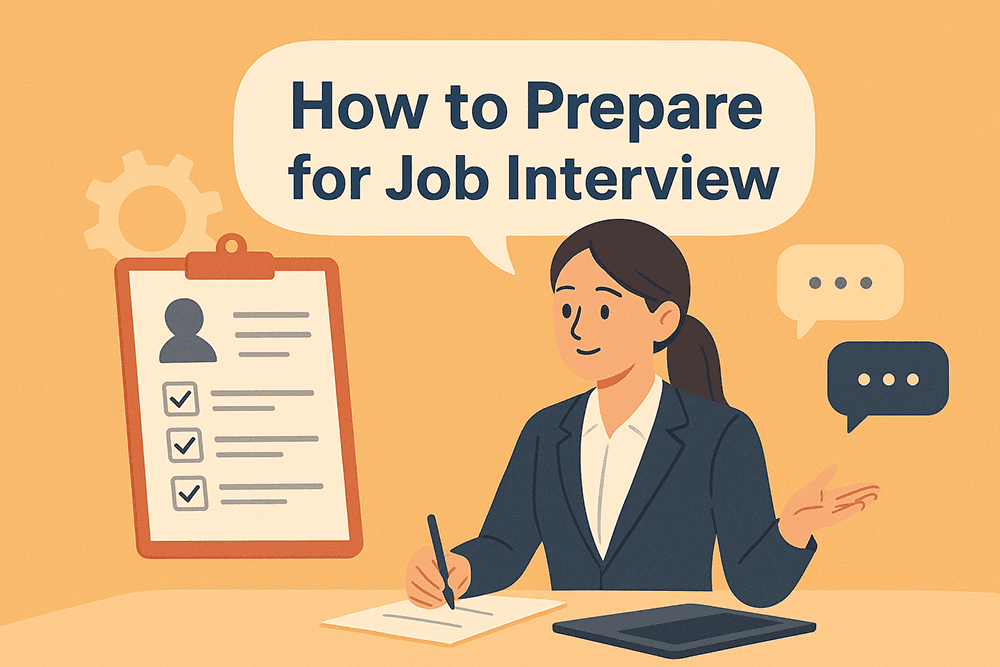
The Ultimate Guide to Preparing for Job Interviews
Interview success is rarely accidental. Learn how to research, practice, answer tough questions, and follow up with confidence in this complete guide to preparing for job interviews.
Adeshina Babatunde
March 21, 2026
A great interview rarely comes down to luck. Most strong performances are the result of deliberate preparation: understanding the role, researching the company, practicing clear examples, and showing up with confidence and curiosity. If you have ever left an interview thinking, “I know I could have answered that better,” the good news is that interview skills can be learned and improved.
This guide walks through a practical, step-by-step approach to interview preparation. Whether you are applying for your first job, changing careers, or aiming for a senior role, the fundamentals are the same: know your value, tailor your message, and prepare for the conversation behind the questions.
Why interview preparation matters
Hiring decisions are not based only on qualifications. Interviewers are trying to answer a broader set of questions: Can this person do the job? Will they work well with the team? Do they understand our business? Are they motivated and reliable? Preparation helps you address all of those concerns clearly and consistently.
Well-prepared candidates tend to do three things better than everyone else:
They communicate relevant experience instead of listing everything they have ever done.
They provide evidence through examples, outcomes, and measurable results.
They build trust by appearing organized, thoughtful, and genuinely interested.
In many hiring processes, several candidates may meet the technical requirements. The interview often becomes the deciding factor. That is why preparation should be treated as part of the application process, not something you do the night before.
Start with the job description
The job description is one of the most useful interview prep tools you have. It tells you what the employer values, what problems they need solved, and which qualifications are likely to be tested during the interview.
Identify the core requirements
Read the posting carefully and highlight:
Required skills and qualifications
Preferred experience
Key responsibilities
Tools, systems, or methodologies mentioned repeatedly
Soft skills such as communication, leadership, adaptability, or collaboration
Then translate those points into likely interview themes. For example, if the role emphasizes cross-functional collaboration, expect questions about teamwork, stakeholder management, and conflict resolution. If it focuses on data analysis, be ready to discuss how you use data to make decisions.
Map your experience to the role
Create a simple match list with two columns:
What the employer needs
Proof that you can deliver it
This exercise helps you avoid vague answers. Instead of saying, “I am a strong communicator,” you can say, “In my last role, I led weekly updates across product, sales, and support teams, which reduced project delays by 15%.”
When you prepare examples in advance, you make it easier for interviewers to picture you succeeding in the role.
Research the company like a serious candidate
Strong candidates do more than skim the company homepage. They understand the business well enough to speak intelligently about its goals, challenges, and market position. This signals interest and helps you tailor your answers.
What to research before the interview
Company mission and values: Review the About page and careers page.
Products or services: Understand what the company sells and who it serves.
Recent news: Look for funding announcements, product launches, acquisitions, leadership changes, or expansion plans.
Industry trends: Know the broader context affecting the business.
Interviewers: If you know their names, review their LinkedIn profiles to understand their roles and backgrounds.
Useful sources include the company website, LinkedIn, recent press releases, and reputable business publications. If the company is public, investor materials can provide valuable insight into strategy and priorities.
Turn research into better answers
Research is only useful if you apply it. For example, if the company is expanding into a new market, you might emphasize your experience launching projects under tight timelines. If customer experience is a stated priority, prepare examples that show empathy, responsiveness, and problem-solving.
Good interview preparation is not about memorizing facts. It is about understanding what matters to the employer and connecting your experience to those priorities.
Prepare answers to the questions you are most likely to face
Most interviews include a mix of common, behavioral, situational, and role-specific questions. You do not need a script for every possible question, but you do need a strong framework for answering clearly.
Master your introduction
You will almost certainly hear some version of “Tell me about yourself.” This is not an invitation to recite your resume from top to bottom. A strong answer should be concise, relevant, and forward-looking.
A useful structure is:
Present: What you do now and your current focus
Past: Relevant experience that prepared you for this role
Future: Why this opportunity makes sense for your next step
Keep it to about 60 to 90 seconds. Focus on the experiences most relevant to the role you want.
Use the STAR method for behavioral questions
Behavioral questions often begin with phrases like:
“Tell me about a time when...”
“Give me an example of...”
“Describe a situation where...”
The STAR method is one of the most effective ways to answer them:
Situation: Set the context
Task: Explain your responsibility
Action: Describe what you did
Result: Share the outcome, ideally with a measurable impact
For example, if asked about handling conflict, do not stay at the level of general principles. Walk through a real situation, your approach, and what changed because of your actions.
Prepare a bank of versatile stories
Rather than trying to predict every question, prepare 6 to 8 strong stories that can be adapted across topics. Include examples related to:
Leadership
Teamwork
Problem-solving
Conflict resolution
Failure or setback
Achievement
Adaptability
Initiative
For each story, note the challenge, your actions, and the result. Quantify outcomes whenever possible. Numbers make your examples more credible and memorable.
Examples of useful metrics include:
Revenue growth
Cost savings
Time saved
Customer satisfaction scores
Project completion rates
Error reduction
Team productivity improvements
Practice the right way
Practice is essential, but not all practice is equally effective. Reading answers silently is not enough. You need to hear how you sound, notice where you ramble, and improve your delivery.
Use mock interviews
Practice with a friend, mentor, coach, or colleague. Ask them to challenge you with follow-up questions so you can get comfortable thinking on your feet. If no one is available, record yourself answering common questions and review the playback.
Pay attention to:
Clarity and structure
Length of answers
Use of filler words
Confidence and pace
Whether your examples actually answer the question
Avoid sounding over-rehearsed
The goal is not to memorize perfect scripts. Over-rehearsed answers can sound stiff and make it harder to adapt when the interviewer asks something unexpected. Instead, memorize key points, transitions, and examples. Think in bullet points, not paragraphs.
A good test is whether you can answer the same question in slightly different ways while keeping the core message consistent.
Prepare for virtual interviews too
Video interviews are now common across many industries. Technical issues and poor setup can undermine an otherwise strong conversation.
Before a virtual interview:
Test your internet connection, camera, and microphone
Choose a quiet, well-lit space
Close unnecessary tabs and notifications
Keep your resume, job description, and notes nearby
Look at the camera regularly to simulate eye contact
Even in a remote setting, professionalism still matters. Dress appropriately, sit upright, and avoid multitasking.
Prepare your own questions
One of the biggest missed opportunities in interviews is failing to ask thoughtful questions. Good questions show that you are evaluating the role seriously, not just hoping to be selected.
What strong questions reveal
Your questions can demonstrate strategic thinking, curiosity, and maturity. They also help you assess whether the role is actually right for you.
Consider asking about:
How success is measured in the first 90 days
The team structure and cross-functional relationships
Current priorities or challenges for the role
Management style and communication expectations
Opportunities for growth and development
For example, asking “What does success look like in this role after six months?” is far more effective than asking only about perks or vacation policy in the first conversation.
Questions to avoid early on
Some topics are important, but timing matters. In an initial interview, avoid leading with questions that focus only on salary, time off, or how quickly promotions happen unless the interviewer raises them first. Those topics can be discussed, but they should not dominate your early conversations.
You should also avoid questions that are easily answered by reading the company website. Asking basic factual questions can make it seem like you did not prepare.
Plan the logistics and your professional presence
Interview performance is influenced by more than your answers. Small logistical details can affect your confidence and the interviewer’s impression.
Before the interview day
Confirm the date, time, format, and location or video link
Research the route if it is in person and plan to arrive 10 to 15 minutes early
Print copies of your resume if needed
Prepare a notebook and pen
Choose professional attire that fits the company culture
If you are unsure about dress expectations, it is usually safer to be slightly more formal than too casual.
Body language and communication cues
Interviewers notice how you carry yourself. You do not need to perform confidence, but you should aim to project calm professionalism.
Focus on:
A firm but natural greeting
Good posture
Attentive listening
Steady eye contact
Clear, measured speech
One underrated skill is pausing before you answer. Taking a moment to think can make you sound more thoughtful and composed than rushing into a response.
Handle difficult questions with confidence
Some questions feel uncomfortable because they touch on weaknesses, employment gaps, career changes, or past failures. The key is to answer honestly without becoming defensive or overly negative.
Talking about weaknesses
A strong answer names a real area for improvement, explains what you are doing about it, and shows progress. Avoid clichés that sound insincere, such as “I work too hard.”
For example, you might say that you used to hesitate when delegating, then explain how you developed clearer processes and improved team efficiency by trusting others more effectively.
Explaining gaps or transitions
If you have a resume gap or are changing industries, keep your explanation straightforward and future-focused. Briefly explain the context, then shift to what you learned and why you are ready now.
Employers are usually less concerned about the gap itself than they are about whether you can explain it with confidence and connect it to your next step.
Discussing salary expectations
When salary comes up, be prepared with a realistic range based on market research, your experience, and the role’s scope. Use reliable sources such as salary benchmarking sites, recruiter conversations, and industry reports.
If possible, frame the discussion around the total opportunity and your interest in finding a mutual fit rather than naming a number too early without context.
Follow up after the interview
Your work is not done when the interview ends. A thoughtful follow-up can reinforce your interest and help you stand out.
Send a thank-you note
Send a brief thank-you email within 24 hours. Thank the interviewer for their time, mention one or two specific points from the conversation, and reaffirm your interest in the role.
A simple structure works well:
Express appreciation
Reference a meaningful part of the discussion
Restate your enthusiasm and fit
Close professionally
Keep it concise. The goal is to be memorable and courteous, not to repeat your entire interview.
Reflect while it is fresh
After each interview, write down:
Questions you were asked
Answers that went well
Areas where you hesitated
What you learned about the company and role
This habit helps you improve quickly across multiple interviews. Over time, you will notice patterns and become much more effective.
Conclusion: preparation creates confidence
The ultimate secret to interview success is not having a perfect personality or the most impressive resume. It is preparation. When you understand the role, research the company, build strong examples, practice your delivery, and follow up professionally, you dramatically improve your chances of making a strong impression.
Start early. Review the job description, prepare your STAR stories, practice out loud, and develop thoughtful questions. Every hour you invest before the interview can pay off in clearer answers, stronger confidence, and better results.
If you have an interview coming up, do not wait until the last minute. Create your preparation checklist today and treat the interview like the high-value opportunity it is.
You might also enjoy

Smart Questions to Ask Interviewers That Make You Stand Out
10 min read

How to Talk About Your Weaknesses in an Interview Without Losing the Job
9 min read
How to Answer “Tell Me About Yourself” Like a Pro
9 min read

25 Common Interview Questions and How to Answer Them
10 min read
Comments
No comments yet. Be the first to share your thoughts!
Leave a comment